BIBLE OPEN. HEART OPEN.
WHEN GOOD
THINGS BECOME
GOD THINGS.
Let’s talk about what gets the highest place in our hearts.
A good thing can become a misplaced thing. Together, we’ll follow the Scriptures, look at the shift, and bring it into everyday life.
5 teaching sections · Your pace · Scripture first
STAY ROOTED
✳
HIS PLACE.
LET’S START HERE
THE GIFT CAN’T
TAKE THE PLACE
OF THE GIVER.
We’re going to slow down and look closely.
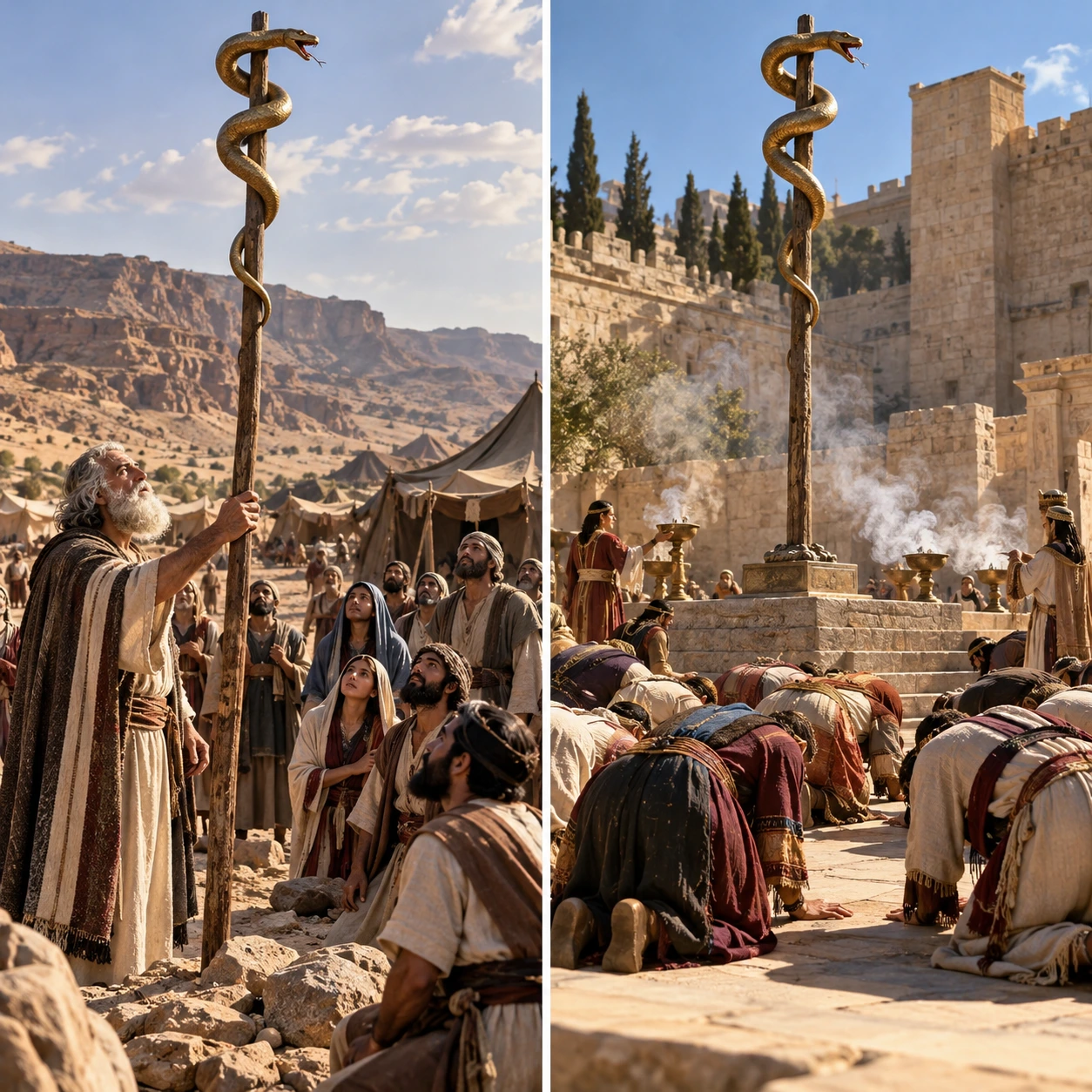
God instructed Moses to make a bronze serpent. Generations later, people were burning incense to it. The object had not changed. The way people treated it had.
That shift is the focus of this study. We’ll trace it through Scripture. Let’s understand idolatry, recognize the art of mixture, and keep our devotion in its rightful place.
Open your Bible. Let’s study. ↗ONE BIBLE STUDY · FIVE SECTIONS
RETURN TO THE TEACHING.
ONE SECTION AT A TIME.
Progress saves in this browser.
KEEP THIS CLOSE
HONOR WHAT
GOD HAS DONE.
KEEP YOUR TRUST
IN HIM.
Meaningful history does not make something worthy of worship.

GO BACK TO THE SOURCE
THE SCRIPTURE
LIBRARY.
Read the passage before the explanation.
Follow the context. Let the Word lead.
Passage links open Bible Gateway in a new tab. Teaching summaries are paraphrases, not Bible quotations. Choose your preferred translation there.
TAP INTO THE MEANING
THE WORDS.
THE WEIGHT.
Tap a term to unpack it. Tap again to return.
A SIMPLE WAY TO STUDY
READ.
NOTICE.
RESPOND.
Read the whole passage.
Notice who is speaking, what happened, and what comes before and after.
Separate the text from the takeaway.
Start with what Scripture says. Then consider the explanation and its application.
Put understanding into practice.
Write down what you learned. Choose one concrete step of obedience. Bring it to God in prayer.
TAKE THE TEACHING WITH YOU
FOOD FOR
THOUGHT.
Take a moment with this. You don’t have to rush your answer.
These scenarios give us space to connect the study to everyday life. We can talk through them in class, and you can return to them afterward. Open a scenario, read the Scripture connection, and write what stands out to you.
Your reflections are personal. They stay in this browser on this device and are not sent to Aneasha or posted publicly. On a shared device, someone using the same browser could see them. Download a copy to keep your writing.
01When the blessing becomes the thing you cannot live without
THE SCENARIO
A woman spends years praying for a husband. She remains faithful, serves in ministry, and trusts God with her future. Eventually, she marries a wonderful man. She recognizes him as an answered prayer.
Over time, however, her relationship with God begins to change. She stops praying as consistently. Her decisions revolve around keeping her husband happy, even when those decisions conflict with her convictions. She begins compromising things she once considered nonnegotiable because she fears losing the marriage.
When confronted, she says, “But I prayed for this man. God gave him to me.”
Go back to the Word.
The bronze serpent was originally an instrument God provided for healing. Generations later, the people burned incense to it. The object had not changed. The people’s relationship to the object had changed.
Sit with this.
- At what point did the blessing become more important than the One who blessed her?
- How do you recognize when gratitude has turned into misplaced devotion?
- If God required you to surrender something He originally blessed you with, would you obey?
02When our desires become the authority over our decisions
THE SCENARIO
A young man building his career desperately wants recognition. He works hard, produces excellent results, and enjoys being successful. None of those things are inherently wrong.
But he begins comparing himself to everyone around him. When someone else receives an opportunity, he becomes resentful. When he is overlooked, he feels worthless.
Eventually, he starts exaggerating his accomplishments and undermining coworkers to get ahead. He knows those actions violate his convictions, but he believes he cannot afford to lose the opportunity.
Go back to the Word.
Colossians 3:5 explicitly identifies covetousness, or greed, as idolatry. The issue is not simply wanting something. It is the desire becoming disordered and controlling.
Sit with this.
- What happens when a desire becomes so powerful that we are willing to disobey God to satisfy it?
- What does our reaction to being denied something reveal about its place in our hearts?
- When we are willing to sin to obtain something, what does that suggest about its authority over us?
03When we refuse to let go of what God used in a previous season
THE SCENARIO
A worship leader remembers a particular worship experience where she encountered God in a powerful way. The music, atmosphere, and moment remain deeply meaningful to her.
Over time, she begins believing that genuine worship must look and sound like that experience. When worship happens differently, she becomes critical. She dismisses other expressions of worship because they do not reproduce the moment she remembers.
She begins chasing the experience rather than focusing on the God she encountered.
Go back to the Word.
The Israelites had a legitimate history with the bronze serpent. It represented a real event in which God provided healing. But its history did not justify turning it into an object of worship.
Sit with this.
- Can we become so attached to the way God moved before that we stop recognizing Him apart from that experience?
- How do we honor what God has done without becoming dependent on reproducing it?
- Are we seeking God’s presence, or are we seeking a familiar feeling?
04When parental approval becomes an idol
THE SCENARIO
A young man grows up in a household where his parents’ approval means everything. As a child, he learns that being obedient, achieving success, and making his parents proud are the things that make him feel loved, accepted, and valuable.
Now he is a young adult. He loves God and genuinely desires to live according to His Word. But every major decision is filtered through what his parents will think. He believes God is leading him in a particular direction, consistent with Scripture, but his parents disagree.
He delays and questions himself. Eventually, he abandons the decision because he cannot bear the possibility of losing their approval. When asked why, he says, “I just want to honor my mother and father. The Bible tells us to do that.”
Go back to the Word.
Having an emotional struggle with parental approval is not automatically idolatry. These feelings may arise from conditioning, fear, or an unhealthy family dynamic. The spiritual concern is knowingly compromising convictions or obedience to God to preserve that approval.
Sit with this.
- At what point does honoring your parents become allowing their approval to occupy a place that belongs to God?
- Are you honoring your parents, or are you depending on their approval to feel worthy?
- If your parents’ expectations contradict what Scripture teaches, whose authority governs your decision?
05When someone else’s revelation replaces your relationship with God
THE SCENARIO
A man loves God. He attends church regularly, listens to Christian podcasts, follows popular ministers, and spends hours watching sermons and biblical teachings online. He is constantly consuming spiritual content.
He can quote his favorite preacher and share revelations he has heard from other people. But he rarely opens his Bible for himself. His prayer life has become inconsistent. He struggles to explain what a passage actually says or why he believes it.
When someone challenges his favorite minister’s teaching, he becomes defensive because he trusts the person who said it. When encouraged to study independently, he responds, “But I’m feeding my spirit every day. All I listen to is the Word!”
Go back to the Word.
Listening to sermons and learning through others is not inherently idolatrous. God gives teachers to equip believers. The danger emerges when a teacher receives unquestioned authority or their influence overrides Scripture. The Bereans examined even Paul’s teaching against the Scriptures.
Sit with this.
- Can we become so dependent on someone else’s relationship with God that we neglect developing our own?
- Can you explain what you believe using Scripture, or can you only repeat what your favorite minister said?
- If the person you follow began leading you away from biblical truth, would you know enough of God’s Word to recognize it?
MAKE ROOM FOR YOUR OWN STUDY
THE WORD.
YOUR NOTES.
REAL GROWTH.
This is space for your own observations, Scripture connections, and next steps.
Notes stay in this browser on this device. They are not sent to your teacher. Download a copy to keep them.
LET’S KEEP THE CONVERSATION GOING
LET’S
CHAT.
Something in the study stood out? Let’s talk about it.
Maybe you want to understand a Scripture better or work through something this study brought to your attention. You can send me a question right here.
This is a private conversation. Your message comes to my inbox, and I’ll respond to the email address you leave below. Your question won’t be posted on the site.
Let’s keep growing in the Word together.
Aneasha
Replies come by email. This is not a live chat.
A little space to talk.
Just your question and a way for me to reply.
KEEP WALKING WITH THE WORD
A HEART
UNDIVIDED.
“Unite my heart to fear thy name.”
Psalm 86:11 · King James Version
Return to the study ↗